


Hop, step, and jump. Hop, step, and jump.
Training for the 2004 Summer Olympic Games, could think of little else than the triple jump cadence.
Hop, step, and jump. Hop, step, and jump.
Then at practice, hop, step, and crack—followed by intense pain, doctors, and confirmation that his Olympic dreams shattered along with his ankle.
Dixon spent the next few years figuring out who he was off the field—the place where athletic ability and subsequent praise had become closely linked to his sense of identity. It was a journey as difficult—if not more so—than his climb to peak performance. During that dark, confusing time, he promised himself: If I’m ever in a position to help others transition to life after sports, I will.
Since July, Dixon has served as Â̲èֱ²¥’s director of athletic diversity and inclusion and assistant coach for the men’s and women’s track and field teams. He is eager to return to the field as a coach, and he has a game plan to use the new role to promote a culture of inclusion. This job is personal, Dixon said.
“I was one of only a few African American kids in elementary school. People would ask to touch my hair, and I felt different until fifth grade, when I performed in front of my peers and teachers at a district track meet,” he said. “For the first time, I felt accepted and embraced, and from then on, my identity was as an athlete. I loved it, don’t get me wrong, but it was difficult to adjust once I left the arena.”
Dixon never had an African American teacher or coach other than a friend’s dad who, after selling insurance all day, volunteered for Dixon’s high school track and field team. “I had amazing coaches and teachers, but I never saw myself in those roles,” he said. These and other life experiences inform his outlook on this new role and emphasize the importance of his presence at Augsburg, where he also teaches Introduction to Kinesiology.
“I am meeting student-athletes and talking with them about the challenges they face. I am working to be a presence on campus—to break down stereotypes for some and to be a role model for others,” he said. “Alongside student-athletes and our athletics administration, I want to create or enhance academic resources, life-skills development, and networking opportunities.”
Personal connections and consistent, centralized support are critical to the success of underrepresented student-athletes, Dixon said. “Augsburg is already ahead of the game. The student body is diverse, and there are many resources across campus that support inclusion. I plan to work with and build on what’s already there.”
A plan—starting with breakfast
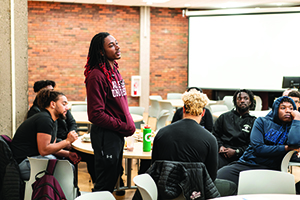
As the sun rose on the second Thursday in October, Dixon greeted several tables of student-athletes seated in The Commons in Christensen Center. The young men of color connected with each other over breakfast before hearing advice from Jareck Horton, district sales manager
at PDC IDenticard, and Augsburg Football Assistant Coach . Dixon plans to invite successful men of color from a range of professions to these monthly networking socials, and he will hold similar events with other groups. ’20 MAE, graduate assistant coach for track and field, said she and other students are thrilled with Dixon’s enthusiasm and vision for the role.
“In a world where, many times, the odds are stacked against us, leaders of color provide hope and strength,” said Schuelke, a student in the Master of Arts in Education program. “I came to Augsburg for the MAE program, but I was pleasantly surprised to find how diverse the campus is, and it is my absolute favorite part of my learning experience.
“If we can move the needle toward a more diverse group of leaders that better represent our country’s demographics, then students of color will begin to understand that the sky’s the limit in terms of their own hopes, dreams, and aspirations.”
“Alongside student-athletes and our athletics administration, I want to create or enhance academic resources, life-skills development, and networking opportunities.”
—Chris Dixon, director of athletic diversity and inclusion
Position the result of NCAA diversity grant
Dixon’s position is largely made possible through a two-year NCAA Ethnic Minorities and Women’s Internship Grant, which provides financial assistance to member institutions who create full-time, entry-level administrative positions for people who identify as an ethnic minority and/or a woman, according to federal guidelines. The grant also supports professional development and formalized mentoring.
Augsburg was one of only 20 institutions and conference offices selected to receive the grant this cycle, and it is the third award for Augsburg in the past decade. The university first secured the Ethnic Minorities and Women’s Internship Grant during the 2012 to 2014 cycle to fund Jennifer Jacobs’ role as assistant director of NCAA compliance and assistant volleyball coach. In 2014, Augsburg received the NCAA’s Strategic Alliance Matching Grant, which funds full-time, mid- to senior-level athletics administration positions during a five-year commitment. Jacobs’ role then evolved into assistant athletic director of external relations and diversity and inclusion, in addition to her role as assistant volleyball coach. She is now head volleyball coach at Augustana University.
Augsburg’s Associate Athletic Director Kelly Anderson Diercks said the department is driven to advance diversity and inclusion. “Embracing and connecting students of all backgrounds and experiences is the right thing to do, but it is also smart,” she said. “More diverse teams are often stronger teams. They produce student-athletes who are better prepared to excel in play and in life.”
Anderson Diercks is a product of the NCAA’s diversity grants, first as an intern for the Minnesota Intercollegiate Athletic Conference and then as an assistant director. The experience, Anderson Diercks said, transformed how she operates as a leader in a male-dominated profession. More than a decade has passed, but she remains in contact with the mentor assigned to her during the internship.
“These are critical opportunities for women and minorities to enter into leadership positions with tremendous personal and professional resources designed to equip them with the tools and outlook to navigate difficult roles,” said Anderson Diercks, who formerly served as chair of the NCAA Ethnic Minority and Women’s Internship selection committee. “We are particularly excited about Coach Dixon’s position because, to our knowledge, it is the only role of its kind.”
Augsburg is ‘ahead of the game’
Ali Spungen, associate director of Division III for the NCAA, said that about 130 positions have been awarded through diversity grants during the past five years—that’s more than $36 million in funds for positions and professional development. Augsburg, Spungen said, stands out as a leader in the division, which is well positioned to meet the needs of diverse populations.
“Division III allows student-athletes to play the sports they love within departments also focused on their academics and social engagement,” said Spungen, also a past grant recipient. “These positions empower leaders like Coach Dixon to thrive, which inspires and encourages students. Augsburg clearly cares for its student-athletes and is willing to dedicate time and resources to ensure they are successful and well-rounded.”
Dixon is ready and grateful to come full-circle—to be the coach and teacher he never had and to prepare others for the transitions he never saw coming.
You Might Also Like

Face value
- on November 21, 2019
Balancing the books
- on November 21, 2019