

By Betsey Norgard
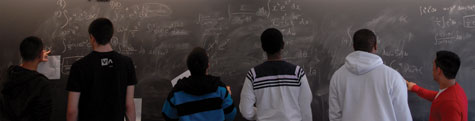
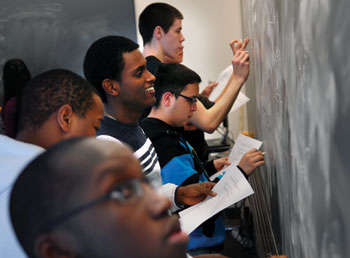 A dozen or so first-year students in groups of threes and fours are talking, scribbling, erasing, and rewriting equations on the board. The professor watches and offers hints as needed. Two student leaders wander around, pausing to respond to questions or give a word of praise. Sometimes students work at tables, but rarely do they listen to a lecture.
Welcome to Calculus Workshop, a twice-weekly elective workshop for students enrolled in Calculus I and II.
Professor Rebekah Dupont is the Augsburg coordinator of the North Star STEM Alliance, a program that seeks to increase the number of minority students who complete degrees in STEM—science, technology, engineering, and mathematics. She developed Calculus Workshop as a strategy to help these students succeed in college-level mathematics courses.
The workshop particularly targets the needs of underrepresented minorities, first-generation college students, and women in majors that require calculus, but any student taking Calculus I or II who is interested in working collaboratively and setting high performance standards is welcomed.
The first workshop began as a pilot in fall and spring last year, starting with 12 students. At the end of spring semester, the results were impressive. The mostly-minority students in the workshop achieved a 0.6 higher grade point average (GPA) than the Calculus I and II students not in the workshop, despite having entered college with an overall lower average ACT score and GPA.
So, now in its second year, Calculus Workshop is an official department offering. Just why is it so successful? To begin with, Dupont grounds it in the research and best practices developed for STEM students participating in workshops linked to academic courses. She designed the workshop for students to preview the material to be presented in their calculus class, reinforce it, and synthesize it by working together to solve problems.
The intent of the workshop is not remedial, but to promote high levels of academic excellence, which also promotes retention. Its major objective is to build community and collaboration among students, who, in this case, are mostly in their first year.
Not your classroom calculus
Jazmine Darden took the pilot Calculus Workshop last year and credits it in large part for the grade she received in Calculus I. One factor for her was that the workshop is hands-on, not class lectures.
“Workshop teaches in a different manner … There are many days that we, the students, are up at the chalkboard solving problems,” says Darden. “Or other times we are given worksheets and work in small groups … Workshop is a very team-oriented and group-oriented environment.”
Darden also finds the workshop a comfortable environment. “Workshop is very diverse,” she continues. “It’s nice to walk into Workshop and see other students just like me. It gives us all an extra push to strive for success.”
Mathematics + opportunities
In addition to building community, the workshop has emerged as an effective means for Dupont to connect first-year students with leadership, academic, and research opportunities. In some cases, these are opportunities such as study abroad and Fulbright awards that wouldn’t be familiar to students whose parents have not attended college.
“We have so many programs to support and help students, but they have to get connected to them,” Dupont says. “They have to hear about these opportunities and then start thinking about them.” Several of last year’s students have become McNair Scholars, which provides them summer research and ongoing support to apply to graduate school. Some have joined the North Star STEM program and work closely with Dupont.
It was in this workshop where sophomore Fred Vedasto heard about the Minneapolis schools’ summer Guys In Science and Engineering (GISE) program, which brings middle- school boys to Augsburg for hands-on science exploration, with Augsburg students hired as mentors.
“It was all about the kids for me,” Vedasto says. He loved feeling like a “big brother” while helping teach them science— it meant letting them have some fun and fool around, but also making sure they got the work done.
Workshop big brothers and sisters
Two student mentors assist Dupont in the workshop. These students also offer help beyond calculus. One of last year’s mentors, Gaby Hamerlinck, was a senior biology and math major. She says that she and junior Tom Lopez, another mentor, helped students prepare for exams, learn how to approach their professors, and answer questions about college life.
“There were a few student-athletes in the group who did not think that a math major and collegiate sports could work in their schedule,” Hamerlinck says. “But being a multi-sport athlete as well, I was able to help them with time management, which allowed them to succeed on and off the field.”
This year’s student mentors are Darden and Trevor Rodriguez Sotelo, both sophomores and workshop students from last year. They are closer in age to the workshop students and believe this makes a difference in connecting with their mentees around campus, sometimes eating and studying together. “Workshop has allowed me to build relationships with many first-year students in and out of the classroom,” says Darden. “I don’t like to be called a tutor to these students because I have built a relationship that is so much more.”
“As a student leader, it’s important to be a positive role model in the classroom,” says Rodriguez Sotelo. “… but my biggest challenge has been how to be a positive role model of life. … I hope that if I can teach them a thing or two about schoolwork and also about everyday life, they will have a more enjoyable experience throughout their college career.”
Research—jumping right in
Students in the workshop are expected to set high goals for themselves. While first-year students do not usually begin research in their first year, Dupont seeks funding and encourages them to connect with faculty about research opportunities.
Sometimes it takes a little push from Dupont—which is how Vedasto got into his physics research project last spring. “She was asking,” he says, “but it wasn’t a question.”
With NASA funding, physics professor David Murr, junior Chris Woehle, and Vedasto developed a payload of instruments to measure light that was launched in a rocket 40 miles high as part of a nine-college project. Vedasto determined the rocket’s navigation using math calculations. He plans to continue research with Murr again this summer.
Vedasto says the research helped him figure out his interests. “I always thought I wanted to be an electrical engineer, and my research confirmed this,” he says. “It was fun, interesting, and helped me get a feel for what I wanted to do.”
Last spring, Dupont also helped Hamerlinck and first-year student Kayla Johnson secure funding for research with mathematics professor John Zobitz, who had taught calculus to both of them. They studied the spread of the flu through a contained population of Augsburg day students.
With the project, Hamerlinck and Johnson had to face the challenges of learning how to present their research at poster sessions, which they did at three events in late spring. “It was a great experience, and I wish I had been able to do it sooner in my career at Augsburg,” Hamerlinck says. “But I’m so proud of Kayla for getting it done her freshman year!”
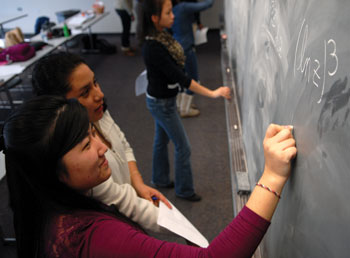
Working together with Hamerlinck was great for Johnson. “Gaby pushed me, helping me with study skills, with balancing my time, and mainly showing me that I could do it.” This combination of faculty, upper-level student, and first-year student research is a nontraditional model, but proving especially important to increase the participation of underrepresented groups in mathematics, Zobitz says. “Gaby gave Kayla some helpful advice about courses and navigating a four-year degree that I (as her adviser) could not.”
What does Zobitz see the students gain from the research experience? “The first-year students see a direct connection between their coursework and research topics,” he says. “For Kayla, I tried to give specific readings commensurate with her skills, typically tied to her calculus textbook.”
“The upper-level students have an opportunity for reinforcement of previously learned skills by having to communicate with younger students,” continues Zobitz. “More importantly, this is an opportunity for mentorship and collaboration. … It was important to foster a sense of community that this is a shared, collaborative endeavor, rather than each person pursuing their own individual research.”
Especially exciting for Dupont last summer was to secure research spots for all six of the North Star STEM workshop students by the end of their first year. An incredibly valuable experience
Students have high regard for Calculus Workshop, even those who may have signed on reluctantly because of the extra time involved. One student, with a heavy work schedule in addition to classes, found out how valuable the workshop could be when his Calculus I grade improved from a failing first test to a score in the 90s on a subsequent one.
Dupont enjoys watching the growth of the students. “At the beginning, going to the board was so hard for them,” she says. “They’re so smart and have ideas in their head, but they fear they’re wrong. For them, it’s about gaining the confidence to be on their feet and get to the point where they want to know how to fix what they do wrong and take that understanding to the next level.”
Hamerlinck, who is now working toward a PhD in evolutionary biology on a scholarship at the University of Iowa, agrees: “The best part for me was watching the students grow more confident in themselves and their academic skills.”
For Kirubel Gezehegn, a current student in the workshop who graduated from British schools in Zimbabwe, the transition to American college life was difficult. “The workshop prepared me for learning about American education, seeing that processes here are different, and it helped my understanding.” He welcomes the challenges—“I don’t want to breeze through and think about what I could have done with the time.”
It’s clear, however, among all students, that a key to much of the workshop success has been the leadership of Dupont, whom Vedasto refers to as “the godmother of our class.”
Darden says, “I am so thankful for all the opportunities I have been given in the last couple of years due to North Star STEM, Rebekah Dupont, and my upper-class mentors.” She says that there’s nothing she would rather do than “give back and try my best to give these opportunities to other students.”
In an e-mail to Dupont, Johnson writes, “Without your help and my experience in Workshop, I would have missed out on so many opportunities.”
She continues, “I’m so glad I said ‘why not?’ and filled out that application for Workshop. … Isn’t it crazy how one choice can make such a huge impact on someone’s life?”