We were asked to preach a sermon series on the public church at St. Michael鈥檚 Lutheran Church in Roseville, MN during Lent. The remaining services have since been canceled to allow for social distancing. This sermon was the last sermon we preached on Wednesday March 11, 2020. We wanted to share it with you, our partners, because we think it speaks to the tension and anxiety we find ourselves ministering in these days.听
There is an irony in asking a congregation to 鈥渂e public鈥� when the times call for social distancing. The purpose of the Public Church Framework is to move us into a humble relationship with our neighbor for our neighbor鈥檚 sake. And sometimes the best thing we can do for our neighbor is disengage and physically distance ourselves. At times like this we must find new ways to be public, new ways to proclaim God鈥檚 mercy in the midst of fear.
Fear & Mercy
March 11, 2020
Ezekiel 47:3-5
“Going on eastwards with a cord in his hand, the man measured one thousand cubits, and then led me through the water; and it was ankle-deep. Again he measured one thousand, and led me through the water; and it was knee-deep. Again he measured one thousand, and led me through the water; and it was up to the waist. Again he measured one thousand, and it was a river that I could not cross, for the water had risen; it was deep enough to swim in, a river that could not be crossed.”
Through the Riverside Innovation Hub at 绿茶直播, we convene learning communities of congregations and ministry leaders. These learning communities explore new ways of being engaged in their contexts that create opportunities for the mutual sharing of good news with our neighbors.
We practice and teach this through the Public Church Framework.听Below is a collection of videos and blogs to illustrate the Public Church Framework. Included are stories from congregational members involved in the Riverside Innovation Hub sharing examples of what the good news has looked, felt, and sounded like in their communities.
Today’s blog post comes from Jeremy Myers’ sermon at 绿茶直播’s chapel on January 21, 2020. To listen to his message, click the soundcloud link below. To read his message, you can find the transcript below the soundcloud link.听
I don鈥檛 want to stand here in the wake of Dr. King鈥檚 day and give you a bunch of my words. So, my intent is to allow Dr. King tell us what it means to live our lives as public people of faith. But, to get there, I must share a couple of my own stories.
Those of you who have been confirmed in a Lutheran church might be familiar with the question, 鈥淲hat does this mean?鈥� It is the question Martin Luther uses through his small catechism to help his readers begin to understand what the various confessions of faith in that catechism might mean for their daily lives. It is a powerful question within the Lutheran tradition. One we should always keep in front of us.
In November of 2014 we put my father into assisted living because his dementia was beginning to the win the fight for his mind. He had been a Lutheran pastor his entire professional career and he loved asking the 鈥淲hat does this mean?鈥� question. One day a local pastor came to the assisted living home to lead a bible study. This pastor turned to my dad and asked him when he had last experienced Jesus鈥� love in his life. My dad looked the pastor square in her eyes and responded, 鈥淲hat does this mean?鈥� I鈥檓 not sure if my father understood the pastor鈥檚 question. He could not remember how to take communion. He couldn鈥檛 remember the words of his favorite bible stories or hymns. He no longer even remembered who I was, but he held on tightly to this question, What does it mean?
Drawing of MLK done by Jeremy Myers’ father
In April of 1968 my father was a 26 year-old seminary student doing an internship at an African-American congregation in St. Louis. He was assigned to preach the Sunday after Dr. King was assassinated. He couldn鈥檛 find the words to write a sermon, so his pen and pencil sketched this picture听as he asked himself, What does this mean? My dad was trying to figure out what it meant to be a pastor in the wake of Dr. King鈥檚 assassination. What does it mean to be a public Christian leader in the midst of pain, and suffering, and tragedy and evil?
Before I go further into Dr. King鈥檚 sermons, I first have to give you some context. This is from his Letter from a Birmingham Jail.
First, I must confess that over the past few years I have been gravely disappointed with the white moderate. I have almost reached the regrettable conclusion that the Negro鈥檚 great stumbling block in his stride toward freedom is not the White Citizen鈥檚 Council-er or the Ku Klux Klanner, but the white moderate, who is more devoted to 鈥渙rder鈥� than to justice; who prefers a negative peace which is the absence of tension to a positive peace which is the presence of justice; who constantly says: 鈥淚 agree with you in the goal you seek, but I cannot agree with your methods of direct action鈥�; who paternalistically believes he can set the timetable for another man鈥檚 freedom; who lives by a mythical concept of time and who constantly advises the Negro to wait for a 鈥渕ore convenient season.鈥� Shallow understanding from people of good will is more frustrating than absolute misunderstanding from people of ill will. Lukewarm acceptance is much more bewildering than outright rejection.
This is me. He is talking to me. And, I believe my father knew Dr. King was talking to him as well. Dr. King is a radical, calling us to be radical
Dr. King has given us many ways of thinking about what it means to be a public Christian leader. In August of 1963 Dr. Martin Luther King Jr. was asking and addressing this question. He and others were arrested for protesting segregation in Birmingham, Alabama. He had been criticized by Christian and Jewish clergy for breaking the law and being an extremist. He penned the famous Letter from a Birmingham Jail in response. Let me read an excerpt from it.
YOU spoke of our activity in Birmingham as extreme. At first I was rather disappointed that fellow clergymen would see my nonviolent efforts as those of an extremist. . . But as I continued to think about the matter, I gradually gained a bit of satisfaction from being considered an extremist.听
Was not Jesus an extremist in love? — “Love your enemies, bless them that curse you, pray for them that despitefully use you.”听
Was not Amos an extremist for justice? — “Let justice roll down like waters and righteousness like a mighty stream.”听
Was not Paul an extremist for the gospel of Jesus Christ? — “I bear in my body the marks of the Lord Jesus.”听
Was not Martin Luther an extremist? — “Here I stand; I can do no other so help me God.
So, the question is not whether we will be extremist, but what kind of extremists we will be. Will we be extremists for hate, or will we be extremists for love? Will we be extremists for the preservation of injustice, or will we be extremists for the cause of justice?鈥�
When someone asks, What does it mean to be a public Christian, it is safe to say, it means to be an extremist for love.
The 鈥渢ransformed nonconformist鈥� is another phrase Dr. King uses to describe the calling of the Christian in the public square. He says . . .听
“In spite of this prevailing tendency to conform, we as Christians have a mandate to be nonconformists. . .听
The hope of a secure and livable world lies with disciplined nonconformists, who are dedicated to justice, peace, and brotherhood.听听The trailblazers . . . have always been nonconformists.听听In any cause that concerns the progress of [humankind], put your faith in the nonconformist! . . .”
Nonconformity in itself, however, may not necessarily be good and may at times possess neither transforming nor redemptive power. . . Paul [in Romans] offers a formula for constructive nonconformity: 鈥淏e transformed by the renewing of your mind.鈥澨齆onconformity is creative when it is controlled and directed by a transformed life and is constructive when it embraces a new mental outlook.
Only through an inner spiritual transformation do we gain the strength to fight vigorously the evils of the world in a humble and loving spirit.听听The transformed nonconformist, moreover, never yields to the passive sort of patience that is an excuse to do nothing.听. .听
[They] recognize that social change will not come overnight, yet [they] work as though it is an imminent possibility.
When someone asks, What does it mean to be a public Christian, it is safe to say, it means to be an extremist for love, a transformed nonconformist.
Dr. King uses the title of drum major to name both our desire to be the best and our call to be servants. He says . . .听
“let us see that we all have the drum major instinct. We all want to be important, to surpass others, to achieve distinction, to lead the parade.
Do you know that a lot of the race problem grows out of the drum major instinct? A need that some people have to feel superior. A need that some people have to feel that they are first, and to feel that their white skin ordained them to be first. . . And think of what has happened in history as a result of this perverted use of the drum major instinct. It has led to the most tragic prejudice, the most tragic expressions of man’s inhumanity to man.”
[God says], “Oh, I see, you want to be first. You want to be great. You want to be important. You want to be significant. Well, you ought to be. If you’re going to be my disciple, you must be.” But [God] reordered priorities. And [God] said, “Yes, don’t give up this instinct. It’s a good instinct if you use it right. It’s a good instinct if you don’t distort it and pervert it. Don’t give it up. Keep feeling the need for being important. Keep feeling the need for being first. But I want you to be first in love. I want you to be first in moral excellence. I want you to be first in generosity. That is what I want you to do.”
And so Jesus gave us a new norm of greatness.
Yes, if you want to say that I was a drum major, say that I was a drum major for justice. Say that I was a drum major for peace. I was a drum major for righteousness.
When someone asks, What does it mean to be a public Christian?, it is safe to say, it means to be an extremist for love, a transformed nonconformist, a drum major for justice.
Dr. King also calls us to be of tough mind and tender hearts. Or maybe to be informed citizens, thoughtful stewards, critical thinkers, and responsible leaders. He says, . . .听
[God gives us] a formula for action, 鈥淏e therefore wise as serpents, and harmless as doves.鈥� It is pretty difficult to imagine a single person having, simultaneously, the characteristics of the serpent and the dove, but this is what Jesus expects. We must combine the toughness of the serpent and the softness of the dove, a tough mind and a tender heart.
Jesus reminds us that the good life combines the toughness of the serpent and the tenderness of the dove. To have serpentlike qualities devoid of dovelike qualities is to be passionless, mean, and selfish. To have dovelike without serpentlike qualities is to be sentimental, anemic, and aimless.听
When someone asks, What does it mean to be a public Christian?, it is safe to say, it means to be an extremist for love, a transformed nonconformist, a drum major for justice, a tough-minded serpent, and a tender-hearted dove.
And Dr. King new the source of these things. He knew the source of love, the source of transformation, the source of justice, of toughness, and of tenderness. And so did the psalmist in our text today.听
Psalm 146:3-9
3听Do not put your trust in princes, 听听听in mortals, in whom there is no help. 4听When their breath departs, they return to the earth; 听听听on that very day their plans perish.
5听Happy are those whose help is the God of Jacob, 听听听whose hope is in the听Lord听their God, 6听who made heaven and earth, 听听听the sea, and all that is in them; who keeps faith forever; 7听听听who executes justice for the oppressed; 听听听who gives food to the hungry.
The听Lord听sets the prisoners free; 8听听听the听Lord听opens the eyes of the听blind. The听Lord听lifts up those who are bowed down; 听听听the听Lord听loves the righteous. 9听The听Lord听watches over the strangers; 听听听he upholds the orphan and the widow, 听听听but the way of the wicked he brings to ruin.
It is God who brings justice to the oppressed, food to the hungry, freedom to the prisoners, and sight to the blind. And it is God who brings us to the oppressed, to the hungry, to the prisoners, and to the blind. To be a public Christian is to be a tough-minded, tender-hearted, transformed, nonconforming, extremist for love who boldly follows Christ into the fears and heartaches of this world.
This week’s story is written by Stephen Richards, a congregational learning partner at St. Luke’s Episcopal Church. Steve writes about his transformation throughout the process of practicing the Public Church Framework.听
Ever had an argument in the car with your partner about the 鈥渞ight way鈥� to get somewhere? My wife and I frequently have such 鈥渄ebates鈥�, and it often boils down to this: she likes to plan how to get somewhere in advance, whereas I鈥檓 more of a 鈥渨ing-it鈥� guy. She likes to pre-navigate potential traffic snarls and find the most economical route to get somewhere, whereas I know where I need to go, have a vague idea of how to get there, and if there are any holdups along the way I鈥檒l navigate my way around them based on what looks like the best option at the time. Needless to say, my wife and I often find driving together a frustrating experience.
St. Luke’s Episcopal Church.
This past year, working with the Riverside Innovation Hub has felt a lot like driving with my wife. When St Luke鈥檚 first started this journey and I was invited to be part of the team, I was excited about the idea of working to get more young people to come to church. Of course I wanted more young people coming to church; I wanted lots of people to come to church. However, I quickly began to realize that this was not the point. So I pushed back. If this is not about getting people into church, then what is it about? I remember regularly expressing a sense of frustration to our coach that I simply had no idea what we were trying to achieve. The 鈥済oal鈥� was to find ways to connect with young adults in our community, but how to do that and what that might look like was opaque. 鈥淪o what鈥� and 鈥淲hat next鈥� questions dominated my thinking. I found the process frustrating. I wanted a road map. I wanted a planned route from Point A to Point B. The trouble is, that鈥檚 not the way this works. You see, when you start asking 鈥淲hat is God up to in our community?鈥� you鈥檙e heading into uncharted territory.听
For too long I鈥檇 been looking for God inside the church building, and many 鈥渟olutions” for how to address the dearth of young adults in our churches often begin there. If only our services were more exciting, if only we had better programming and the like. Using such reasoning we also talk about how God is or is not working in our midst. More people in church equals God is working, and vice versa. But instead, we were told to reflect on Ezekiel鈥檚 vision of the river flowing from the temple, and imagine this flowing out into our community. I liked the image, but continued to push back. I made the point that if the river was flowing from the temple then surely this means the river is flowing out from our church building? Our coach patiently allowed me to navigate my way through this.听
When I joined this project I thought it was about connecting young adults to God in church. However, as we began to follow the river (both inside and outside of our community), I suddenly realized that it was about a different kind of connecting. In fact, it was me who was connecting with God as I began to realize my entire understanding of mission had been grounded in the notion that there was nothing of God going on outside 鈥渋n the world.鈥� Sitting inside a church building, I鈥檇 been staring at the walls wondering why more people weren鈥檛 inside with us, rather than going outside and asking them. The walls were preventing me from engaging with people. They were a physical barrier between our community and our neighbors. Whereas the veil separating us from God had been torn down in Christ, and in the years since then we had been physically and theologically putting it back up.
As we walked the three art forms, I became to see where God is at work outside the church. I should not have been surprised, because God is always at work everywhere! How do I know this? Because God is everywhere. There is no place where God is not:
鈥淲here can I go from your Spirit? Where can I flee听from your presence? If I go up to the heavens,听you are there; if I make my bed听in the depths, you are there鈥� (Psalm 139:7-8).
Once I began to realize that church is not the Ground Zero, the modus operandi of God鈥檚 activity in any community, I began to realize that the roadmap of mission I had been using had been leading me away from young adults; leading me further inside the church building (where they are not), instead of outside and into our neighborhood (where they are).
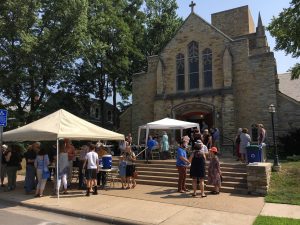
As we continued with Interpretation and Discernment work, I sensed that not only I had changed, but the team had also had a transformation. Our focus had shifted. We had begun to dream and imagine how we might go and meet people, rather than sitting in church waiting for them to come to us. Jesus told us to 鈥淕o,鈥� and we were going. We began to look at ways we were already connecting with our neighbors; the Montessori School in our church building was an obvious one, but also the green space out front. We learned that people were using the chairs we had placed out there, they were tying ribbons to the Peace Pole and using the food box. We decided to focus on that as space as a place where God was present; Holy ground where we could start wading into the river.
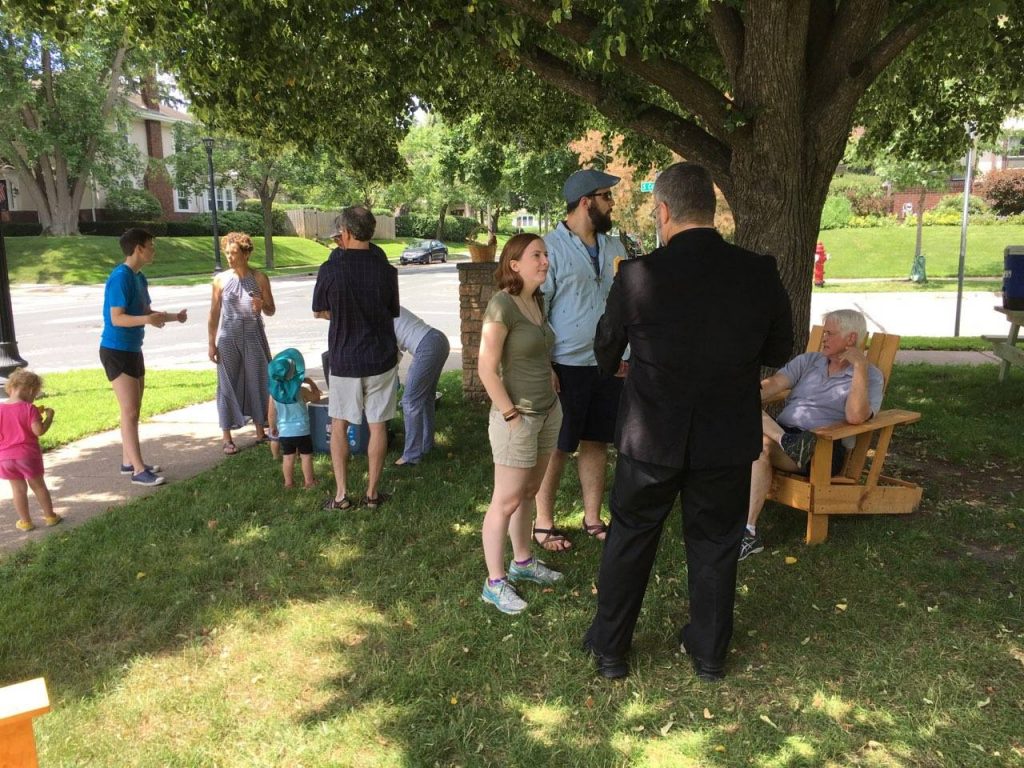
Folks from the congregation and the neighborhood gather at St. Luke’s “front porch” to be together and share ice cream.
And so we began. It was the start of summer and one of our team suggested we might offer people free ice cream after church on Sunday. So we did. We named it Ice Cream Sunday. For three months we stood outside the church eating ice cream, and inviting our neighbors to join us. In doing so we met lots of people and got to know their stories. We got to tell them our stories, but we never used this as a recruitment tool; just a way of showing love to those around us, you know, doing the very thing Jesus told us to do (Matthew 2:39). And as we did this week after week, relationships began to form. Barriers came down. We began to wade into the river; first ankle deep, then knee deep and finally waist deep. Some people came back just to hang out with us; people who had never stepped inside our church building. And as we listened to their stories we realized that God was at work in their lives and in our community. In fact, God had always been working in our community, we鈥檇 just never taken the time to go outside and listen. But now we were outside, and listening, and starting to see the walls come down. We鈥檇 torn up the roadmap, and with the Spirit鈥檚 leading had started to 鈥渨ing-it鈥濃��
This week we hear from Ellie Roscher, a congregational learning partner at Bethlehem Lutheran Church. Ellie shares a story about the mutual transformation that comes from listening to and empowering young adult leaders.听
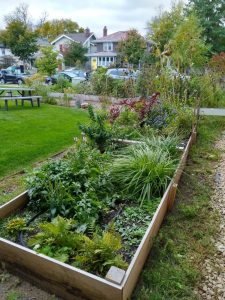
The Garden at Bethlehem Lutheran Church in Minneapolis.
Siri, a talented and emerging folk singer, spends significant time on the road playing music. In between tours, she works at the front desk at Bethlehem even though she is skeptical of institutional religion and questions the existence of God.听
About a year ago, Siri found herself in a cycle of despair. She was feeling adrift and unsure of where her community was. And she was feeling cynical, angry and overwhelmed about climate change. She could hear the earth moaning and see it crying out. One night, in response to her lament a friend kindly offered, 鈥淲ould it help to do something about it?鈥澨�
Siri took the challenge to heart. She floated her idea of starting a community garden to me and some other folks at Bethlehem. Yes, yes, yes. We helped her flush out her vision and celebrated with her when she received a generous Foundation Grant. Then it was time to begin.听
At the Riverside Innovation Hub, our guiding text is from Ezekiel 47. In it, we are led away from the temple to deeper water. Along the riverbank there are lush trees with fruit for food and leaves for healing. Siri had a prophetic vision to grow a garden outside the walls of Bethlehem. Bethlehem, a large and resourced church, had not yet leveraged its voice and power to address climate change in real and meaningful ways. We recognized Siri鈥檚 passion and vision as beautiful, and we met her there, downriver, to put her plan to action.听
Planting a seed requires the audacity of hope. Tilling the soil quiets the mind, brings peace to the heart, and slows time just a bit. Weeding is a spiritual practice. Watching seed transform is a living metaphor. Fresh air shakes the dust from our souls. Billowing clouds invite us to look all the way up and remember that we are small.
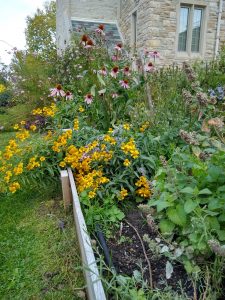
The late-fall blooms of the garden.
Siri was ready to move from despair. Her leadership invited others to do the same. She built beds, planted seeds, watered them and tended to them. She showed up week in and week out and created a space outside the walls of Bethlehem for folks to gather. Sunday school kids came out into the sunshine to guess what sprouts would become. A neighborhood kid asked if he could help water the beds, another asked if he could have a cucumber. More neighbors, who previously did not engage started congregating when Siri and volunteers showed up to work. More congregation members lingered outside the church.听
Now, at the end of the summer, the garden has exceeded all of our expectations. It is bursting with life. The sun flowers tower over us. The pollinators bring life and vibrancy and splashes of color. We tended to the earth and it is showering us with bounty. The neighbor who was the most skeptical has thanked Siri for creating a space for folks to gather. Congregation members have thanked her for inviting them out of the sanctuary to God鈥檚 nature.听
Siri, too, has been amazed at the transformation inside of herself. She is a pastor鈥檚 kid, and she has a lot of hurt toward the Christian institution. She sees the harm the church has caused in the world. 鈥淚t has felt like
gigantic tectonic plates shifting in my being,鈥� she said. 鈥淚t has been truly transformational to go from overwhelmed to empowered. And to grow a garden on the grounds of a church has been important for me. I鈥檓 not ready to worship yet, but growing flowers and vegetables here and having the community rally around me has ushered in healing.鈥澨�
Bethlehem鈥檚 innovation team recognized Siri鈥檚 vision and leadership. We built our vision around the growing garden and our growing partnership with folks doing conservation and reforestation in the cloud forest of Guatemala. Siri will be one of the young adults traveling to Guatemala come January, after our garden is harvested. She kept asking me if I should send someone else instead, someone who has more clarity about God and church. I think of Ezekiel and smile. 鈥淣o, you are perfect.鈥澨�
The garden has been a blessing. A physical reminder of God鈥檚 abundance. A place to gather and listen to the soil and and remember whose we are. It brings dignity to get down on our knees and get dirty. Get some earth under our fingernails. Siri said yes to an invitation to grow something new and rich and beautiful. It has given her hope. And community. Fruit for food and leaves for healing. We are all better for it. We are grateful.听
This week, we hear from Mason Mennenga, an Innovation Coach at the Riverside Innovation Hub. Mason shares his understanding of the Public Church Framework and how this approach changes the way faith communities experience their own community and the local neighborhood.
鈥淎 religious experience is not simply another experience, but rather a reconfiguration of the way in which one experiences.鈥澨�鈥� Peter Rollins
Public Church1听 is not another program, ministry, or outreach in which we hope for churches to add to their already-too-long list of programs, ministries, and outreaches.听For far too long, churches have resorted to adding a food pantry, a sexy new Instagram account, or the latest curriculum to their Sunday school programming to engender upon people the need to have a religious experience within their walls. However, perhaps 鈥� and just bear with me 鈥� it is churches who need a religious experience: to be born again. It is the telos of Public Church to do just that 鈥� to reconfigure the way in which a church experiences its own congregation and local community. A church oriented to encountering their neighbor might just discover places of mutual transformation鈥損laces, people, and experiences that breath new life into itself and its adjacent communities alike.
Steph, a congregant and Innovation team member from one of the churches I coach through the Public Church Framework, recently had what one may describe as a religious experience. This church had a month-long adult and youth class leading participants through conversations reflecting on why they are Christian and why they participate in church. At the first session of this class, Steph and I were at a small table with other congregants. During a discussion around the table, several of these congregants voiced concerns about the number of young adults leaving the Church. While our tablemates鈥� anxieties were undeniably real, it seemed to Steph and I that there is more to the cultural trend of young adults leaving the Church than met our tablemates鈥� eyes. Nonetheless, Steph and I remained quiet and simply listened to them. After the session, Steph approached me and told me that if it was not for what she was learning by participating in the Public Church Framework, she would have perfunctorily went along with what our tablemates were saying. Without a doubt, many other people would do the same.听
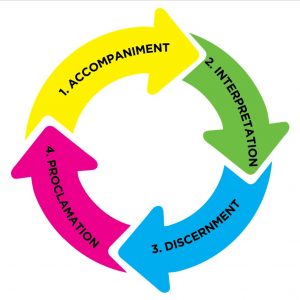
Accompaniment, the first part of the Public Church Framework, invites people to listen to the neighbor. In this case, Steph and her church鈥檚 innovation team listened to young adults. Steph spent time listening to her young adult coworkers and read resources on the engagement of young adults with the Church. She even picked up a copy of Phyllis Tickle鈥檚 The Age of the Spirit to learn more about the theological changes in our culture. All of this work of accompaniment was focused on listening to her neighbors and seeking further understanding of the cultural milieu in which her neighbors live.
Photos of Foss Chapel in mid-winter versus early summer illustrate how experiences vary depending on different lens we use to see the world.
Because of her work with the Public Church framework听鈥� listening with young adults and learning about the rapidly changing culture in which they live听鈥� Steph gained the lens to better understand the complexity of young people leaving organized religion and more faithful responses to such a shift. Her experiences of accompaniment, provided Steph with a lens that opened her up to a religious experience that did not resort to a better catechesis or a catchy new program but a wholly new way in which she experienced young people and their reasons for engaging, or not engaging, with the Church. Steph and the rest of her church鈥檚 innovation team have learned the shift of young adults leaving the church is complex, such as different ways young adults relate to religious affiliation and problematic theologies that are no longer relevant. They are also recognizing that young adults, like most everyone, prefer to be encountered uniquely as a person and not as a demographic label or a problem to be solved.
In the Christian tradition, we have a name for such a religious experience: born again. To be born again was never intended to be a switching of one鈥檚 experience from one or no religious tradition to another another but a conversion of how one experiences the world. Public Church, penultimately, attempts to provide a framework for churches to be a born-again in the way they experience their own congregation and local community. Therefore, allow your church to be born again through the learning framework of Public Church 鈥� not to lead your church into another program, ministry, or outreach but to fracture the way in which your church experiences your own congregation and local community. It begins with listening, one neighbor at a time. It continues through leaning into the curiosities that emerge, being willing to set aside old assumptions, and allowing God to invite new life that can mutually transform church and its surrounding communities alike. 听
1听Public Church is not another program, ministry, or outreach, but rather simply a framework by which churches can cultivate a reconfiguration of culture within their congregations to be more attentive and more faithfully responsive to their local communities.听
Innovation Coach Asefa M Wakjira visits with Partner Congregations Holy Trinity Lutheran Church, Minneapolis and St. Luke’s Episcopal Church, Minneapolis
Written by Sheila Foster,St. Luke鈥檚 Episcopal Church, Minneapolis, MN
This week, we hear from Sheila Foster, an Innovation Team Member at St. Luke鈥檚 Episcopal Church in Minneapolis, MN. Sheila is excited to share her team鈥檚 light-bulb moment during the time of Accompaniment as they have been exploring ways to have authentic conversations with their neighbors.
St. Luke’s Episcopal Church is excited to be a part of the Riverside Innovation Hub Project.听Our team of six, with our Innovation Coach Lindsay Boehmer, has been meeting regularly.听There are others who have joined in on our meetings along the way.
Where the story began.听听Back in December, we were all in the midst of preparing for the Christmas season in the church and in our lives.听After a Sunday morning worship, four team members, including myself, gathered to collectively write our monthly reflection about what we had experienced, discovered, and accomplished in December.听This was not a planned gathering 鈥� it was born out of a moment that most team members were in the same place at the same time. Initially, we set aside 30 minutes with the goal of getting our reflection accomplished before Christmas. However, the time and conversation turned into so much more.听Our 30-minute conversation turned into a 2-hour conversation, and what we discovered helped to move us forward.听
With curiosity and uneasiness came fruitful conversations.听听In our discussion about Accompaniment and what that really meant, there was a realization that asking strangers questions 鈥� putting ourselves in a vulnerable place by engaging with people we do not know or have connection with 鈥� is scary and challenging.听How do we do that in an authentic manner, so we feel confident enough to ask questions and listen?听We reflected on what kind of questions we can ask, what do we need to share of ourselves to be able to ask those questions, and what are we afraid of.听The question then became 鈥� are there more opportunities we might be missing with engaging in a listening post? And can we create a listening post in our local neighborhood that feels relevant and authentic?
In our time of Accompaniment, I had given a lot of thought to spaces in our surrounding neighborhood that St. Luke’s has connections with.听These places included: the space on our church building鈥檚 front lawn which includes our garden where our neighbors pass through and sit; our front lawn where neighborhood children play; our prayer box where people walking by can leave a prayer or take prayer resources; and our emergency food box that makes food available to those in need.听
The light-bulb moment.听听Then, a new place came into my mind; I asked our team about our church parking lot that is a block away.听Some members did not even know that we had a parking lot!听They assumed the parking lot belonged to the surrounding businesses or the Montessori School that we share our building with because their playground is in the parking lot.听
This revelation sparked an incredible series of wondering questions.听 Who parks in the lot? Does the parking lot get used all the time and by the same people?听Do the people in the apartment buildings across the street park in the lot? How can we get to know the people who use the parking lot?听Do they live in the neighborhood or do they drive in from other places? 听There were so many questions about who these people 鈥� local neighbors might be 鈥� and what we might learn from hearing their stories!听
Since this incredible moment of discovery, we have had the opportunity to get to know the businesses surrounding the parking lot. We have made plans with the Coffee Shop, who shares our parking lot, to host a Coffee Hour event with our neighbors.听We are planning to give flyer invitations to the people parking their cars in the parking lot, surrounding business, and nearby apartments. We plan to invite them into a conversation about who our neighbors are. We want to listen to their perspectives about where they see consolation and desolation in the spaces and places we share.
We hope to have an opportunity to listen and realize where God is at work in our neighborhood.听There is now a desire to know the story of others and, hopefully, this will lead to building relationships we did not even know were possible.
The second movement in the public church framework is Interpretation. This is when we move from hearing our neighbors鈥� stories back into the stories of our particular faith communities. This is an incredibly important step and one that is tempting to skip for a few reasons.
We want to skip this step because we might not know what it is we believe as a faith community.
Or we want to skip this step because we think theological and biblical reflection aren鈥檛 as important as action. We want to move straight to action.
We also sometimes think we can skip this step because interpretation will just simply happen without any intentional effort.
Interpretation is an important step in this process because people want to know how faith impacts their daily lives. It is the role of the faith community to help their people learn to see the world in light of God鈥檚 promises. We also want our collective actions to clearly express the essence of who we are, what we believe, and the world we believe God envisions for us. This interpretive move is what makes the public church framework different than many other outreach, or public efforts. Theology matters and this theological turn in our work needs to be intentional.
I have heard pastors say their faith community was not ready to do the work of interpretation because they did not know the bible well nor did they fully understand what the congregation believed. If that is the case, then we have our work cut out for us. Those who gather with our faith communities should know what we believe, they should understand the biblical narrative and how it might still shape our lives. If we plan to engage our neighborhoods in a way that is life giving, then we must think about that engagement theologically. 听
This turn and attention to habits of interpretation urge faith communities to move beyond what they are not – the markers by which they may define themselves against. 鈥淲e are not like that kind of church or those Christians.鈥� It moves a community to more closely claim what they are about, why they exist, and why it matters.
There are three strands, or narratives, that we weave together using the artform of interpretation. We weave together the neighbors鈥� stories we鈥檝e heard in our accompaniment with our own stories as a faith community and with what we believe to be God鈥檚 story. Each of these strands help us better understand the other two strands we are working with. These three strands should enlighten one another as well as push back against and challenge one another. This is slow and tedious work but it is vital to forming both our communities of faith and our work in our neighborhoods.
Here are five main questions offered that guide the work of interpretation. How you chase after the answers to these questions is up to you, but we recommend involving as many other people from your faith community as possible. The more perspectives you get, the richer the dialogue will become.
What are the core theological convictions of our faithcommunity? It is not an expectation of this work that your entire faith community is on the same page with what they believe. There is no expectation of uniform, doctrinal agreement. However, we do believe it is vital for faith communities to be having these conversations even if they lead to the realization that your faith community is incredibly diverse in its theological convictions.
What are the key components (stories, metaphors, etc.) of the biblical narrative that shape our life together as a faith community? Again, the expectation is not uniformity but transparency. There are certain aspects of the bible we think we cling to until we have time to consider it more deeply and we discover these aspects do not really serve a purpose in our daily lives. On the flip side, often 听lesser known parts of scripture might be more helpful or more transformative as you begin digging into them together. Who would have ever thought that we (the Riverside Innovation Hub) would have turned to some obscure vision of Ezekiel when looking for a biblical metaphor to frame our project? We have continued to be surprised and blessed by the profound depth of the Ezekiel text that has shaped this work.
What are the significant events in your faith community鈥檚 history that have shaped your identity?Your community most likely has many stories of sadness and trauma as well as stories of hope and resiliency. Unearth these stories. Learn from them and allow them to show you how they both shape your view of your role in your community and allow them to empower you for that work.
How do these theological convictions, components of the biblical narrative, and events from your past influence the way you hear and understand the stories you encountered in your accompaniment experiences?This is the key theological move. This is when you begin to see and learn not only what your community believes but how those beliefs shape your life together and life with your neighbors.
How do the stories you encountered in accompaniment push back against, challenge, or affirm your core theological convictions and beliefs? The interpretive move is not a one way street. We should be careful not to assume that our theological beliefs are impervious and only help us understand our neighbors鈥� stories. We should also allow our neighbors鈥� stories to interpret our beliefs and understandings about God.Interpretation goes both ways. Our understanding of our neighbor will deepen when we see our neighbor through God鈥檚 story. Our understanding of God will deepen when we see God through our neighbor鈥檚 story.
The public church framework continues to move us to a place where we are ready and able to proclaim good news into the lives of our neighbors that will actually be good news to them because it is speaking to, confronting, or displacing the very real bad news they are facing in their lives. It also continues to move us to a place where we might actually begin to hear our neighbors proclaiming good news to us. In order to arrive in these places, it is vital that we make the interpretive move and learn to hear and see our neighbor through God鈥檚 story and vice versa.
鈥� Video of an architect who works on spatial justice sharing about how to catalyze community healing
Build a Learning Culture
[BOOK]听听 鈥� A business best-selling classic book on how to be a learning organization
Manage & Lead Change
听鈥� A journal article on the role of inclusive mentorship for young adults in building a thriving organization of continuous improvement, collaboration, and innovation
[BOOK]听听听鈥� A New York Times bestselling book on three rules of ‘social epidemics’ and key factors influencing changes



 Bethlehem鈥檚 innovation team recognized Siri鈥檚 vision and leadership. We built our vision around the growing garden and our growing partnership with folks doing conservation and reforestation in the cloud forest of Guatemala. Siri will be one of the young adults traveling to Guatemala come January, after our garden is harvested. She kept asking me if I should send someone else instead, someone who has more clarity about God and church. I think of Ezekiel and smile. 鈥淣o, you are perfect.鈥澨�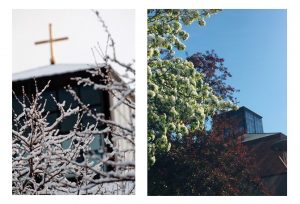

 Understand & Connect Communities
 Build a Learning Culture
 Manage & Lead Change